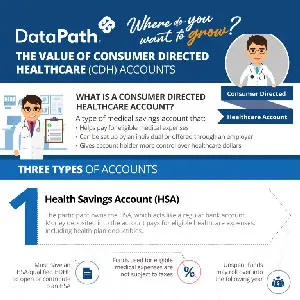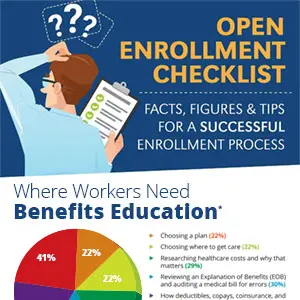
INFOGRAPHIC: Open Enrollment Checklist
Facts, Figures & Tips for a Successful Enrollment Process.
The following infographic provides an overview of facts, figures and tips for employers to have a successful open enrollment process.
Facts, Figures & Tips for a Successful Enrollment Process.
The following infographic provides an overview of facts, figures and tips for employers to have a successful open enrollment process.
It’s open enrollment time. That means third-party administrators (TPAs) are working with clients to set up plans for the new year. We’ve compiled some tips and reminders for benefits administrators to help them through this stressful season. Tip #1: Know Your Audience Each employer group will be different, so tailor your presentation accordingly. Occupation, geographic location, and generational cohort may affect employees’ wants and needs. For example, Millennials, Gen Xers, and Baby Boomers may each
Employment loyalty has shifted dramatically in recent decades. Employers that evolve in response may be surprised at how well their companies perform – and the TPAs and brokers who help them can find new growth opportunities in the process.
This is the last in a four-part series on building benefits packages to resonate with the diverse generations in today’s workforce. Today, we focus on effective strategies and engagement recommendations for Gen Z. Gen Z members are accustomed to an on-demand culture and rely heavily on the internet for news and consumer reviews. The digital age, climate change, financial challenges, and COVID-19 continue to influence this rapidly growing workplace cohort. The Generation Z Profile Born
This is the third in a four-part series on building benefits packages to resonate with the diverse generations in today’s workforce. Today, we focus on effective strategies and engagement recommendations for Millennials. Generation Y, more commonly called Millennials, were born between 1981 and 1996. Millennials experienced rapid technological changes and grew up in an era of Microsoft and Apple, a 24-hour news cycle, and the rise of social media. In their formative years, they witnessed
This is the second in a four-part series on building benefits packages to resonate with the different generations. This article focuses on effective strategies for Generation X, including engagement recommendations. Born between 1965 and 1980, Generation Xers are known for an entrepreneurial mindset, working hard, and playing hard. As enrollment season nears, let’s review this generation’s motivations, which benefits they find most important, and how they learn and communicate. The Gen X Profile Gen Xers
Benefits can determine a company’s success or failure in competing for and holding on to engaged, productive workers. Whereas employers once boasted about their health and retirement benefits, those now serve as simply the foundation for a more complex benefits program needed for remote and hybrid/onsite workers. If we learned anything from the Great Resignation of 2021-2022, it’s that employees need and are demanding more support from employers in terms of their physical, mental, emotional, and
Recent years have significantly changed the employment landscape. Companies everywhere are battling to recruit and retain talented employees. In an economy where workers may have the upper hand, the first response of employers is often to raise salaries and wages. However, research shows that a competitive benefits plan is increasingly vital in attracting and retaining skilled workers. What is a competitive benefits plan? According to a survey by the Adzuna job search site, the five most in-demand
A Section 125 Cafeteria Plan is an employer-sponsored benefits program that lets employees pay for certain qualified medical expenses, such as health insurance premiums, on a pre-tax basis. It’s called a “cafeteria plan” because, like the dining options at a cafeteria, employees can pick and choose the healthcare options they want, such as medical, dental, vision, and other benefits, while declining ones they don’t. It’s important to note that a Section 125 Cafeteria Plan does
Americans live and work longer, leading to a four-generation workforce in different life stages and with differing needs. Creating a benefits package that satisfies their varied needs can prove challenging. Diverse Needs In its latest Workplace Wellness Survey, the Employee Benefits Research Institute (EBRI) examined financial stressors as well as overall financial, emotional, and physical well-being. Financial Well-Being Financial well-being is of moderate to high concern for 28% of younger workers, 37% of middle-aged workers, and